Allergen control
Food Allergen Management: A Guide to Preventing Cross-Contact
Build a connected system from suppliers to labels, covering allergen master data, zoning, production sequencing, cleaning validation, rework and change control.
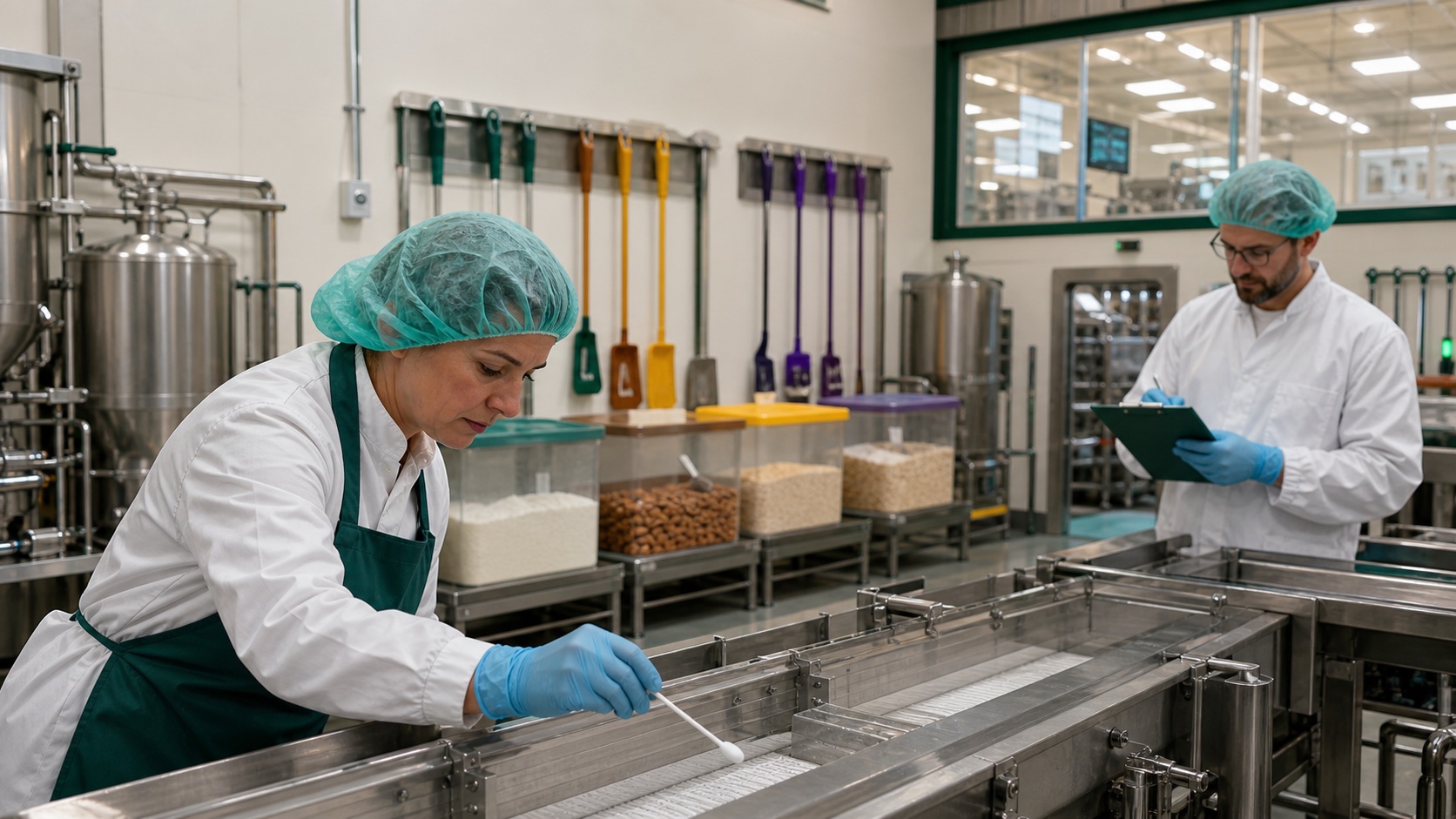
Key takeaways from this guide
- Intentionally added allergens and unintended cross-contact risks require separate controls.
- Allergen master data should be a single source of truth across supplier specifications, recipes, processes and labels.
- A judgment that something looks clean is not validation: risk-based methods and acceptance criteria are needed.
- Coordinate label changes, line clearance and first-product checks.
Why does allergen risk require a different approach?
Food allergies can cause severe reactions in some consumers even at very small quantities. Codex CXC 80-2020 expects businesses to declare allergenic ingredients correctly, reduce the risk of unintended allergen presence and prevent it where possible. Allergen management is part of good hygiene practices and, where appropriate, the HACCP system.
Distinguish two risks. Intentionally used ingredients such as milk, hazelnuts or wheat must be managed correctly in formulations and labels. Cross-contact is unintended transfer of an allergen to another product through equipment, air, personnel, rework, transport or inadequate cleaning. Precautionary allergen labeling cannot substitute for sound process control.
Which allergen list applies?
Allergen lists and labeling formats can vary by market. Annex II of European Union Regulation 1169/2011 lists 14 groups of substances or products that must be declared. In the US, the FDA's major-food-allergen approach operates under a different legal framework. Exporting businesses should not assume one universal list; verify target-market legislation and customer requirements for each product.
This guide is not a legal opinion. Check national legislation, exemptions, derivatives, thresholds and language or emphasis rules against current official sources. The master data model should support situations where the same ingredient requires declaration in one market but has a different name or exemption in another.
Supplier and raw material approval
Allergen control begins before goods reception. Specifications should cover intentionally used ingredients, carriers, processing aids, allergens handled on the same line and the basis for precautionary declarations. A change of supplier, production site or formulation should automatically trigger a risk assessment.
At reception, verify packaging integrity, correct labeling, lot identity and specification version. Assess bulk products and tankers using previous-load information, cleaning certificates and line connections. Quarantine nonconforming or uncertain material; do not release it on verbal supplier confirmation alone.
The allergen matrix and a single source of truth
Each raw material's allergen profile should flow automatically into recipes, semi-finished products and finished products. A matrix goes beyond a present/absent table: it should contain intentional ingredients, cross-contact risk, supplier declarations, market and version information. When a recipe changes, affected products and labels should be identifiable.
Keeping separate recipe, label and allergen spreadsheets creates contradictions. The approved material specification is the primary source; the product allergen profile is calculated from the recipe tree, and label text and quality checks verify that profile. Track manual exceptions with authorized approval and justification.
Zoning, storage and production sequencing
Physical segregation is the strongest control where feasible. Store allergenic raw materials closed, identified and positioned to prevent leakage. Separate dedicated equipment and transport containers by color or identity. For powdered allergens, assess airflow, exposed products and cleaning methods separately.
On shared lines, production may be sequenced from lower to higher allergen profiles. Sequencing alone is not a control: define product changeover, line emptying, cleaning and first-product release together. When the plan changes, the system should reassess the required cleaning level and affected materials.
Cleaning validation and routine verification
Codex calls for appropriate cleaning of equipment and preparation areas between different allergen profiles, choosing methods according to food residues, surfaces, dry or wet cleaning and equipment. Validation demonstrates that a specified procedure can reduce the target allergen to an acceptable level. Include the hardest-to-clean location and the worst-case product.
Routine verification demonstrates that the procedure has been correctly applied at each cleaning. Visual inspection, protein tests and specific allergen tests may be combined in a risk-based programme. Specify sampling locations, method limits, acceptance criteria and deviation actions in advance. A negative surface result cannot compensate for choosing the wrong sample or method.
Rework, personnel and maintenance activities
Use rework only in products with the same or a compatible allergen profile, at a defined proportion and with a lot link. Unlabeled intermediate containers, open pallets and verbal shift handovers increase cross-contact and wrong-recipe risks. Rework quantities should also appear in the mass balance.
Personnel movement, glove and workwear changes, shared tools and maintenance equipment can carry allergens between areas. Codex recommends area-specific clothing and tools where necessary. Post-maintenance line checks should cover parts, cleaning, allergens and first-product inspection.
Label and packaging changeover control
Putting the right product in the wrong packaging is an important cause of allergen recalls. At line startup, match the correct product, label version and packaging code. Count and remove labels and packaging left from the previous job, and have an authorized person approve the first pack.
Compare allergen emphasis, the ingredient list and precautionary statements in the label design with the recipe's allergen profile. Barcode or vision checks can help, but if master data is wrong, automation can print the wrong label perfectly. Link approved artwork, print records and the product lot.
Deviations, complaints and performance indicators
When an allergen deviation occurs, immediately identify the affected time window and hold the affected product lots, then use forward traceability to determine shipment scope. Product disposition depends on risk assessment and an authorized decision. Do not close the root cause as operator error alone; examine planning, label master data, training, equipment and the verification system.
KPIs should go beyond complaint counts. Monitor supplier specification currency, changes closed on time, failed cleaning verification, line-startup label errors, allergen nonconformities and action effectiveness together. Zero complaints alone do not prove that a control is working.
Compilation sources
- Codex Alimentarius (FAO/WHO) — Code of Practice on Food Allergen Management for Food Business Operators (CXC 80-2020)
- European Union — Regulation (EU) No 1169/2011, Annex II — substances causing allergies or intolerances
- U.S. Food and Drug Administration — Food Allergies
- Codex Alimentarius (FAO/WHO) — General Principles of Food Hygiene (CXC 1-1969)
- Food and Agriculture Organization of the United Nations — Risk assessment of food allergens — FAO/WHO expert consultation
Related guides
What Is Food Traceability? A Guide to Building an End-to-End System
A practical framework for connecting lots, events and data so you can trace from raw materials to customers, and from customers back to the source, within minutes.
Global Food Safety Standards: Choosing the Right System
Compare Codex, ISO 22000, FSSC 22000, BRCGS, IFS Food, SQF and GFSI in terms of scope, customer expectations and implementation effort.
Mass Balance in Food Manufacturing: Calculation and Application
Make actual yield visible by reconciling inputs, outputs, stock changes, evaporation, by-products, rework and losses within the same boundary.
How to Prepare a HACCP Plan: 12 Steps and 7 Principles
Build a working HACCP system, from prerequisites and process flow diagrams to hazard analysis, CCPs, critical limits, monitoring, verification and records.